
How sound waves could make AI more energy efficient
Artificial intelligence is driving rapid growth in computing demand, creating a significant energy challenge. A University of Queensland spin-out, Cortisonic, is commercialising a new class of ultra-low-energy computing technology that uses high-frequency sound waves, known as hyper-sound, rather than conventional electronics to process information.
Developed through more than eight years of research at UQ in collaboration with Lockheed Martin, the technology could enable powerful AI applications while dramatically reducing energy requirements.
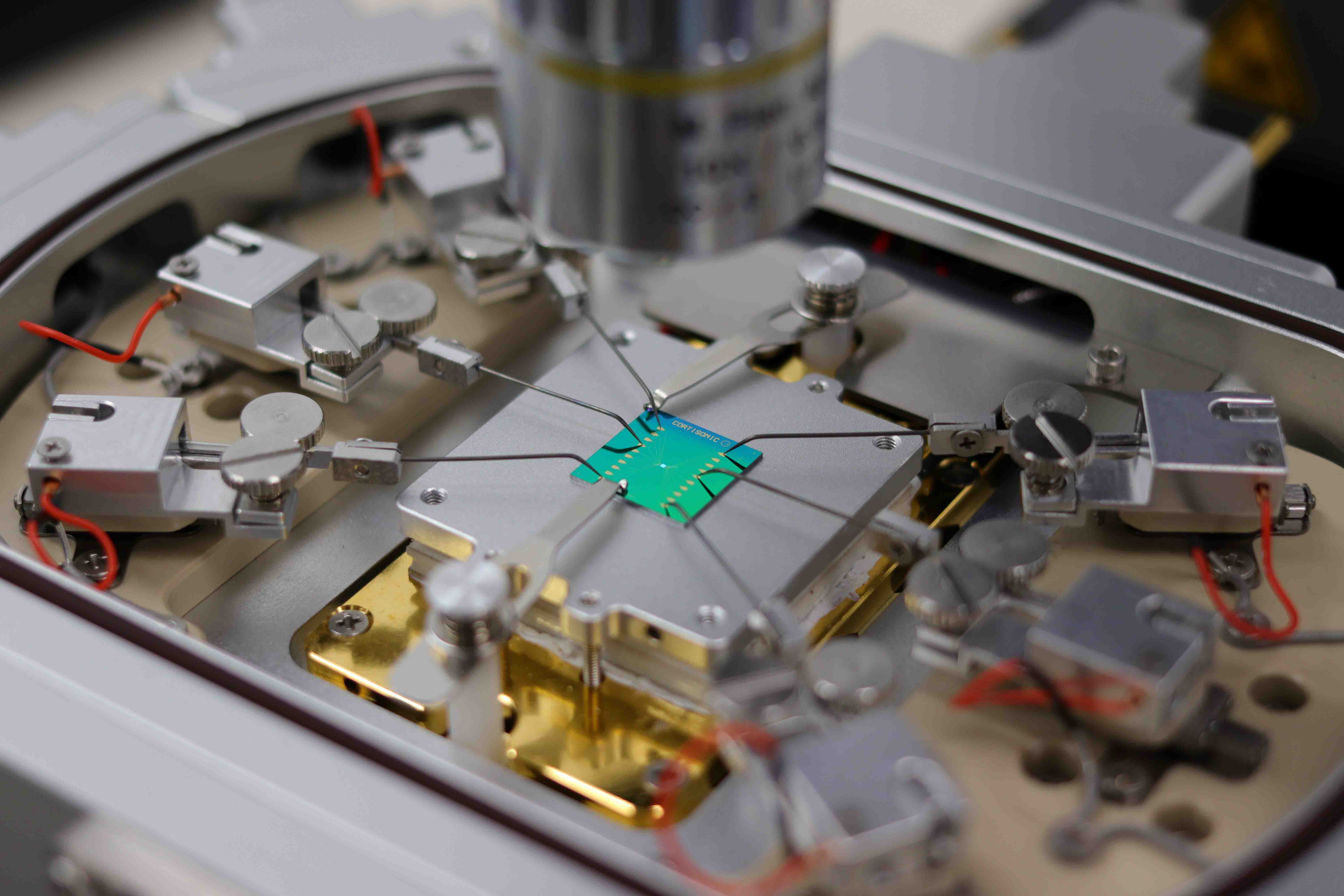
At a glance
- The rapid growth of AI is creating unprecedented demand for computing power and energy, particularly for devices that operate where access to power is limited, such as drones, sensors, wearables and robotics.
- UQ researchers, in collaboration with Lockheed Martin, have developed a new computing architecture that uses hyper-sound waves on silicon chips instead of conventional electronic switching to process information more efficiently.
- Commercialised through UQ spin-out Cortisonic, the technology could significantly reduce the energy required for AI computation, and enable low-power, real-time AI in edge applications.
What's the problem?
As AI models grow larger and more sophisticated, the infrastructure needed to power them consumes increasing amounts of electricity. Reducing the energy required for computing while maintaining performance is becoming a significant challenge as AI becomes more capable and adoption continues to accelerate.
The challenge is particularly critical for Edge AI applications such as autonomous drones, wearable devices, robotics and smart sensors. These systems need powerful computing capabilities but often operate where power and computing resources are limited. Currently, they must either send their data away to be processed or make do with the simple on-board computing.
What's UQ's innovation?
Researchers from UQ’s Queensland Quantum Optics Lab, led by Professor Warwick Bowen, have developed a new way to perform computation using hyper-sound waves, known as phonons, confined within nanoscale structures on silicon chips.
The approach replaces conventional electronic switching with sound-based processing, creating a pathway towards AI hardware that uses significantly less energy than current technologies, and could be deployed in Edge AI cases.
The technology has now been commercialised through Cortisonic, founded by former UQ researchers Dr Glen Harris (CEO) and Dr Christopher Baker (CSO).

How does the technology work?
Most modern processors move information electronically. Cortisonic harnesses hyper-sound waves travelling through precisely engineered nanoscale structures on a silicon chip to process information.
The energy-intensive step of machine learning is untangling raw data into a form where patterns become easy for a model to read. In a standard neural network, this is performed by layers of artificial neurons with millions or billions of connections. Each time you use the model, the input has to be pushed through all those layers, resulting in billions of operations.
Cortisonic’s technology achieves this by letting hyper-sound wave ripple through the chip, which transforms data naturally, then only using computing for the final step of interpreting the result. This approach is particularly effective for processing time-series data, where information evolves over time, including applications such as audio analysis, sensor monitoring, communications, and predictive analytics.
What is the impact?
The technology could enable powerful AI capabilities in Edge AI devices that have to sense and respond in the moment while power is limited, allowing computation to happen on the device itself in real time, without a link to the cloud needed.
It could also help reduce the broader energy demands associated with next-generation computing. The Cortisonic technology is designed to work alongside conventional chips, taking on specific types of computation that are most costly to run electronically. This offers the potential to ease the load on systems already straining under the energy demands of AI.
The Cortisonic chip is manufactured with standard semiconductor fabrication rather than specialist materials, meaning efficiency gains can be delivered through existing supply chains.
The venture also demonstrates how long-term research can translate into real impact. The technology was supported through industry collaboration, Australian Research Council funding and the Queensland Quantum Decarbonisation Alliance before becoming a venture-backed company.
By bringing together researchers, industry, government and investors, the project shows how advanced technologies developed in Queensland can contribute to global challenges such as energy efficiency and decarbonisation.
Did you know?
Cortisonic has built a single chip carrying 10,000 tiny interconnected vibrating structures, each helping to process information as hyper-sound — made using the same manufacturing methods as ordinary computer chips.
What's next?
Having proven that this type of computing can be built at scale on standard silicon, Cortisonic is now focused on validating and scaling its ultra-low-energy computing platform.
Its initial focus is Edge AI, where low-power computing can unlock new capabilities in autonomous systems, robotics, smart devices and other applications that cannot rely on data-centre-scale computing resources.
The team
This project originated in UQ’s Queensland Quantum Optics Lab.
| Professor Warwick Bowen (Project lead) | School of Mathematics and Physics, Queensland Quantum Optics Lab |
| Dr Glen Harris - Co-founder and CEO, Cortisonic | School of Mathematics and Physics, Queensland Quantum Optics Lab |
| Dr Christopher Baker - Co-founder and CSO, Cortisonic | School of Mathematics and Physics, Queensland Quantum Optics Lab |
Partners and investment
Research and partners
- Lockheed Martin
- Australian Research Council Linkage Program
- ARC Centre of Excellence for Engineered Quantum Systems (EQUS)
Innovation ecosystem
- Queensland Quantum Decarbonisation Alliance (QDA)
Key publications
- Harris, G.I., Baker, C. et al. (2026). Tutorial: Membrane phononic integrated circuits. Journal of Applied Physics, 139, 081102.
- Harris, G.I., Baker, C. et al. (2024). Acoustically driven single-frequency mechanical logic. Physical Review Applied, 21, 054029.
- Baker, C. et al. (2024). Directional emission in an on-chip acoustic waveguide. Applied Physics Letters, 124, 013504.
- Baker, C. et al. (2021). Tunneling of Transverse Acoustic Waves on a Silicon Chip. Physical Review Applied, 15, 054036.
Interested in working with this team?
100 UQ AI Innovations Changing the World · Showcasing 100 projects creating change through AI