
How AI finds faulty solar panels hidden in a sea of millions
Australia’s solar generation capacity is on the cusp of rapid growth but underperforming panels cost the industry an estimated $400 million a year.
A University of Queensland (UQ) start-up is using machine learning to find those faults quickly and affordably, helping operators recover lost output without having to install new hardware on individual panels.
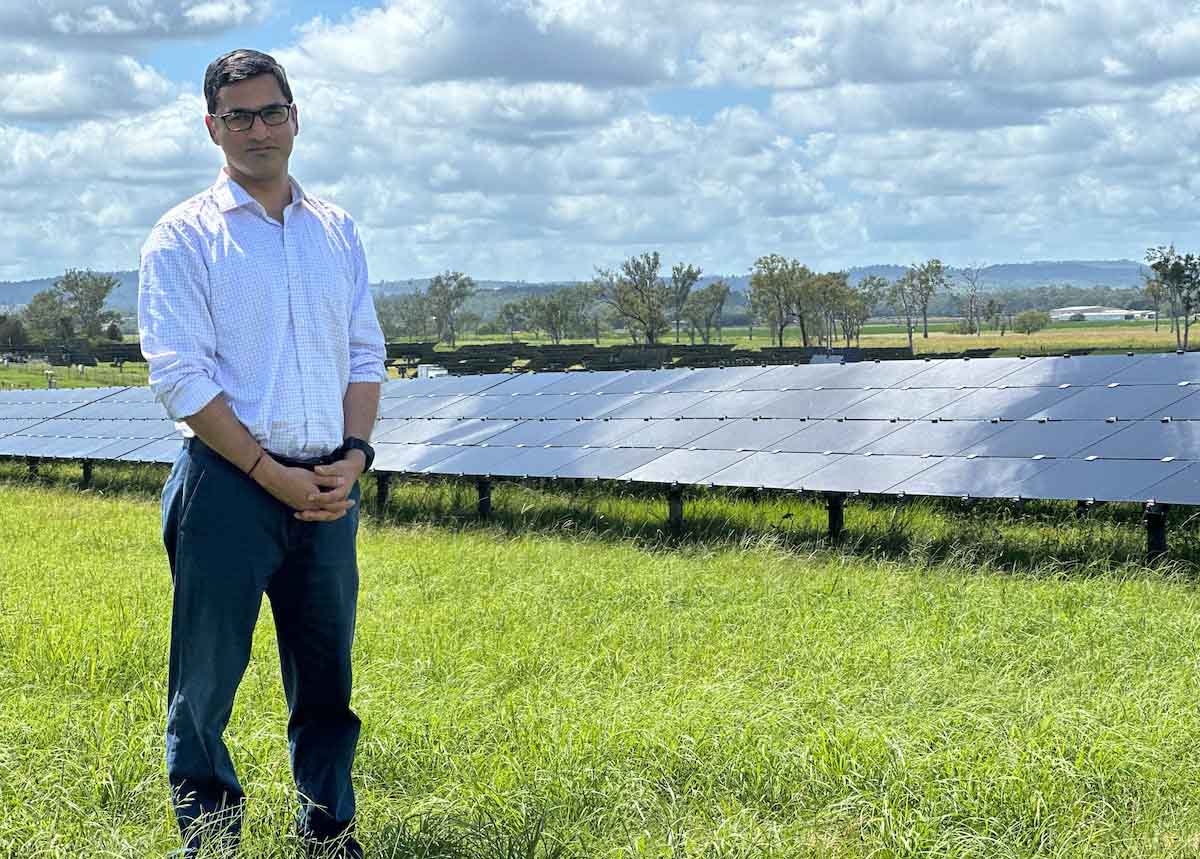
At a glance
- Faulty, dirty or degraded panels are hard to find across large solar farms, and the lost output is estimated to cost Australian operators around $400 million a year.
- UQ start-up SolarisAI uses machine learning to analyse the data that solar farms already generate, pinpointing underperforming panels and diagnosing likely causes without extra monitoring hardware.
- By helping operators target maintenance and recover lost generation, the technology aims to halve panel-related losses, lift revenue and support more reliable solar generation as capacity grows.
What's the problem?
Large-scale solar farms can contain millions of panels. When one degrades, gets dirty, or develops a wiring or tracker fault, it can drag down output — but finding the underperforming panel is challenging.
While conventional monitoring technology can tell something is wrong at a broad system level, it struggles to pinpoint exactly which individual panel is malfunctioning and why. A single degraded, soiled or mis-wired panel can keep dragging down output while staying invisible to the very system meant to catch it.
Potential solutions such as installing extra monitoring hardware on every panel, inspecting each one for damage, or cleaning them all individually are too slow and costly to be practical. Across the country, that lost output adds up: underperformance is estimated to cost Australian solar farms around $400 million every year.
What's UQ's innovation?
Associate Professor Rahul Sharma along with Professor Tapan Saha from UQ’s School of Electrical Engineering and Computer Science, developed a system that uses machine-learning algorithms to analyse the data a solar farm already generates. It detects, locates and identifies faults in real time, down to the level of individual panels.
Commercialised as SolarisAI, the all-in-one system detects faults without installing any additional hardware. It automatically identifies the cause of underperformance and can even predict panel soiling levels so cleaning is targeted only where it is needed. This makes SolarisAI both fast and cost-effective to deploy.
How does technology work?
In a large solar farm, monitoring is usually built into the inverters, which convert the DC electricity generated by the panels into grid-ready AC electricity. Each inverter typically serves a section of the farm: panels are wired into strings, which then feed into the inverters. This gives operators a useful system-level view, but makes faults in individual strings or panels much harder to detect.
SolarisAI closes that gap by extracting the vital information hidden in a farm’s operational data. It then monitors for degradation, soiling, wiring faults and tracker problems, works out the cause of any underperformance, and pinpoints exactly where maintenance is needed – rather than requiring crews to inspect a sea of near-identical panels by hand.
We’re aiming for SolarisAI to reduce losses from underperforming panels by half, and potentially deliver an uplift in revenue of up to 8 per cent.
— Associate Professor Rahul Sharma
What is the impact?
For solar farm operators, the immediate gain is recovering output that would otherwise be lost. Because SolarisAI reads existing operational data, operators can implement it without having to install new sensors.
Industry backers frame effective, efficient asset management as central to keeping the electricity grid reliable as Australia’s solar capacity enters a period of rapid growth.
While SolarisAI was built for utility-scale solar farms, the same approach extends to industrial, commercial and residential solar – anywhere underperforming panels are eating into output.
Did you know?
Underperforming panels are estimated to cost Australia’s solar farms around $400 million a year — losses SolarisAI aims to cut in half without adding a single new sensor.
What's next?
The next milestone for SolarisAI is scaling the technology across commercial and utility-scale solar installations in Australia. In parallel, the team plans to advance the system’s inverter and tracker diagnostic capabilities to identify underperformance and emerging equipment issues. SolarisAI is also exploring opportunities in overseas markets, building industry partnerships and extending the platform’s reach into the global solar sector.
The team
This project is led out of UQ’s School of Electrical Engineering and Computer Science, with commercialisation support from UniQuest.
| Associate Professor Rahul Sharma (Project lead) | School of Electrical Engineering and Computer Science |
| Professor Tapan Saha | School of Electrical Engineering and Computer Science |
Development partner
- Weidmueller Australia
Deployment partners
- EDL Energy
- Edify Energy
- Gentari Solar Australia
Commercialisation and investment
- UniQuest
- Uniseed
- UniQuest
- Investment Fund
Project details
| AI research strength | Scalable and sustainable AI Data-centric AI |
|---|---|
| Industry portfolio | Energy and resources |
| Project hub | solarisai.com uniquest.com.au/available-technology/solaris-ai |
| Key publication | Dhoke, A., Sharma, R. & Saha, T.K. (2020). “A technique for fault detection, identification and location in solar photovoltaic systems.” Solar Energy, 206, 864–874. |
| Related UQ news |
Interested in working with this team?
100 UQ AI Innovations Changing the World · Showcasing 100 projects creating change through AI