
What’s the problem?
Tunnels develop several different kinds of defect as they age: hairline cracks, water leakage, and areas of flaking or segment damage. Left unchecked, these defects can compromise a tunnel’s structural safety. Inspection has traditionally relied on slow, manual survey, while most automated tools are built to find just one type of defect at a time — but defects tend to appear together in the same stretch of lining, in imagery made difficult by poor lighting, staining and surface wear.
What’s UQ’s innovation?
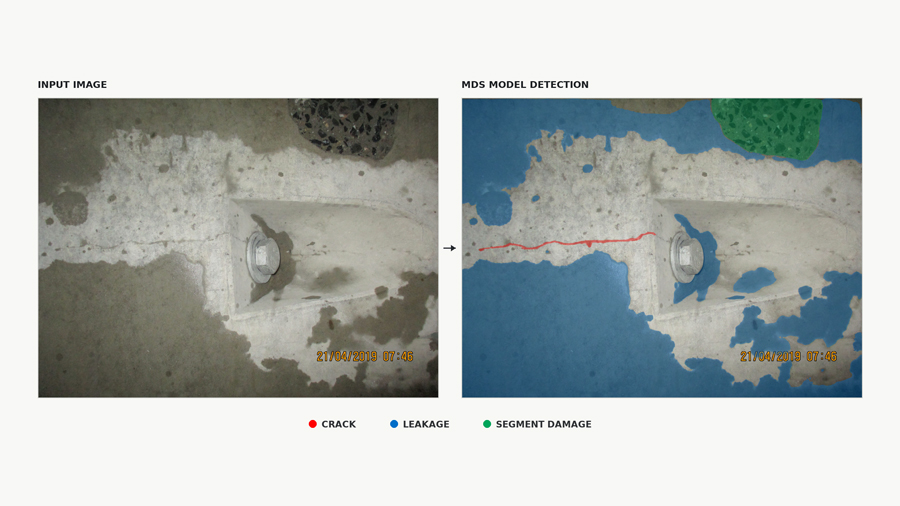
A team of researchers developed a morphology-aware AI system that automatically segments multiple tunnel-lining defects in complex underground imagery.
Rather than pass everything through a single detector, the system sorts each part of an image toward one of two purpose-built components: one that traces the direction and continuity of a crack, and one that maps the extent of broader patches of leakage, flaking and segment damage against the surrounding surface.
A further stage lets the two streams share context — useful because cracks often run through leakage zones — before their readings are combined into a single, labelled defect map. The system achieved an 81 per cent match with expert-labelled images – a strong result for a model working across several types of tunnel defect at once.
To make it practical to run, the team then compressed the finished model to roughly a third of its size with almost no loss in accuracy.
What’s the impact?
A model that segments all defects together, consistently, gives inspectors a fuller picture than tools trained to look for one thing at a time, and does so faster and more repeatably than manual survey. The reduced model size, with virtually no loss in accuracy, ensures it is suitable for automated inspection setups rather than needing to be run on heavy, specialised computers. Together, these point toward tunnel monitoring that is quicker, more consistent, and practical to deploy at the scale required by real inspection programs.
Did you know?
The model was compressed from 114.5 MB to 40.5 MB with almost no loss in accuracy, making it more practical to deploy in real-world settings.
Led by
- Mohan Ren
Project lead · School of Civil Engineering
Project Team
- Dr Jurij Karlovsek
School of Civil Engineering - Dr Yumeng Zhang
School of Mechanical and Mining Engineering - James O'Kane
- School of Civil Engineering
| AI Research Strength | Data-Centric AI Scalable & Sustainable AI |
|---|---|
| Industry Portfolio | Urban Design & Infrastructure |
| Key Partners | Chang’an University · Nanyang Technological University · Xi’an University of Science and Technology |
Published 15 September 2026