
What's the problem?
Magnetic resonance imaging (MRI) is one of healthcare's most powerful diagnostic and monitoring tools, but conventional scanners are expensive, non-portable and require siting in specialised facilities. This limits access to advanced imaging in regional and remote communities and sporting environments where rapid access to imaging could improve outcomes.
The low magnetic field inherent to portable MRI come with reduced image quality and increased susceptibility to electromagnetic interference and noise, which limits their practical use. UQ researchers are using artificial intelligence to help overcome these challenges and bring high-quality imaging closer to where people need it.
What's UQ's innovation?
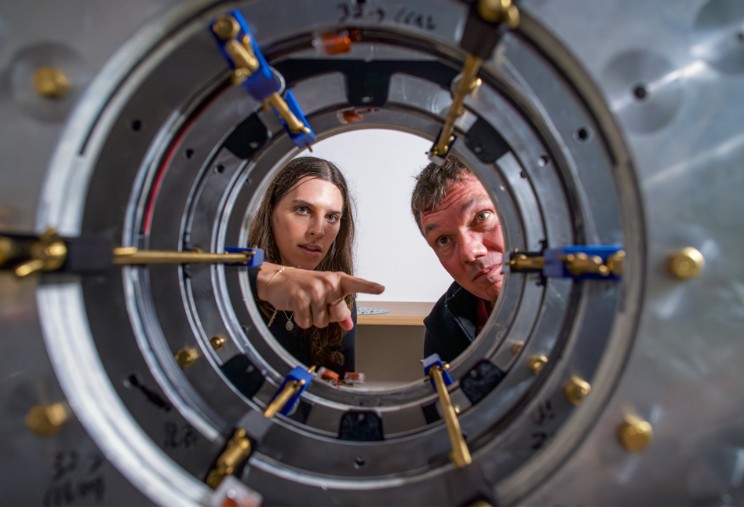
Supported through Quantum Challenge 2032 and Australia's Economic Accelerator (AEA) Innovate program, researchers at The University of Queensland are developing an AI-enabled portable, low-field MRI system designed for use beyond traditional hospital environments.
The team is applying machine learning across several stages of the imaging workflow. AI tools are being developed to suppress electromagnetic noise, reconstruct clearer images from low-field MRI data and retrieve clinically relevant information from scans. By improving the quality and usefulness of low-field MRI data, the technology aims to make portable MRI a practical option for a wider range of healthcare and sporting applications.
The device is being developed with industry partners, Magnetica and Intellidesign.
What's the impact?
AI-enabled portable MRI could expand access to advanced medical imaging by reducing the cost, size and infrastructure requirements associated with conventional MRI systems. Portable scanners could be used in sporting venues, community healthcare settings and locations where traditional MRI infrastructure is unavailable or impractical.
The funded projects focus on musculoskeletal imaging for high-performance athletes, supporting injury monitoring, rehabilitation and performance management through more accessible imaging technologies.
More broadly, the project demonstrates how AI can help address technical limitations in emerging medical technologies, supporting more accessible and affordable healthcare solutions.
Did you know?
Associate Professor Viktor Vegh has spent more than a decade developing low-field MRI technologies with the goal of making MRI more accessible, portable and affordable. His group’s research combines imaging physics, quantitative imaging and machine learning to improve the quality and usefulness of medical imaging data.
Led by
- Associate Professor Viktor Vegh
Principal Research Fellow, School of Human Movement and Nutrition Sciences
UQ Researchers
- Wei Dai
- Rajat Vashistha
- Yoel Garcia Marin
- Jiaxin Du
| AI Research Strength | |
|---|---|
| Industry Portfolio | Health & Biomedical |
| Key Partners | Magnetica · Intellidesign |
| Key Publication | Su, Jiasheng, Pellicer-Guridi, Ruben, Edwards, Thomas, Fuentes, Miguel, Rosen, Matthew S, Vegh, Viktor and Reutens, David. A CNN based software gradiometer for electromagnetic background noise reduction in low field MRI applications. IEEE Transactions on Medical Imaging. 2022;41(5):1007-1016. https://doi.org/10.1109/TMI.2022.3147450 |
| Funding | Quantum Challenge 2032 · Australia's Economic Accelerator (AEA) Innovate |
Published 15 September 2026