
UQ researchers have developed an AI system that can identify birds in drone imagery up to 85 times faster than humans, helping conservationists monitor bird populations more efficiently across vast and hard-to-reach landscapes.
What's the problem?
Bird species are declining worldwide, with many facing an increasing risk of extinction. Effective conservation depends on accurate population monitoring, but collecting this information can be difficult, especially in remote wetlands and other hard-to-reach habitats.
While drones can collect large volumes of imagery, manually identifying and counting birds in thousands of images is extremely time-consuming, limiting the scale and frequency of monitoring programs.
What's UQ's innovation?
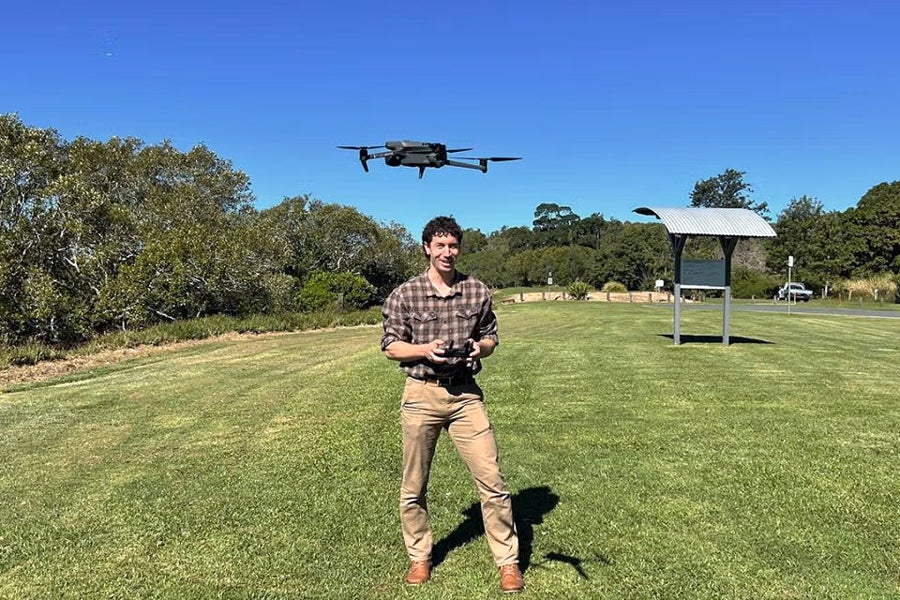
Researchers from UQ's School of the Environment, led by Dr Joshua Wilson and co-authored by Professor Richard Fuller, developed an AI-powered system that automatically detects and identifies birds in drone imagery. The project combines drone technology, computer vision and machine learning to process large volumes of ecological data quickly and accurately.
To develop and test the technology, more than 30 researchers from 11 countries assembled a global dataset containing almost 50,000 birds from more than 100 species, creating one of the most diverse drone-based bird monitoring datasets of its kind.
The resulting AI model and dataset have been released as open-access resources, enabling researchers and conservation organisations worldwide to use, test and improve the technology.
What's the impact?
The study found the AI system could identify birds in drone imagery 85 times faster than humans, dramatically reducing the time required to process survey data.
By enabling drone surveys to be conducted more frequently and at much larger scales, the technology could improve monitoring of threatened bird populations in Australia and around the world. Rather than spending hours manually counting birds in thousands of images, conservation experts can focus on interpreting results, designing monitoring programs and driving conservation action.
The research lays the foundation for using AI to support biodiversity conservation at a time when bird populations are declining at alarming rates globally.
Did you know?
The AI system was trained and tested using a global dataset containing almost 50,000 birds from more than 100 species, making it one of the most diverse drone-based bird monitoring datasets ever assembled.
Led by
| AI Research Strength | Data-Centric AI Scalable & Sustainable AI Resilient Communities and Environment |
|---|---|
| Industry Portfolio | Environment and Agrifood |
| Key Partners | More than 30 researchers from 11 countries contributed images to strengthen the AI identification process and helped construct the paper published in Remote Sensing in Ecology and Conservation. |
| Key Publication | Wilson, J.P., Amano, T., Bregnballe, T., Corregidor-Castro, A., Francis, R., Gallego-García, D., Hodgson, J.C., Jones, L.R., Luque-Fernández, C.R., Marchowski, D., McEvoy, J., McKellar, A.E., Oosthuizen, W.C., Pfeifer, C., Renner, M., Sarasola, J.H., Sokač, M., Valle, R., Zbyryt, A. and Fuller, R.A. (2026), Big Bird: A global dataset of birds in drone imagery annotated to species level. Remote Sens Ecol Conserv. https://doi.org/10.1002/rse2.70059 |
Published 15 September 2026