
What's the problem?
Motor Neuron Disease (MND) is a progressive neurodegenerative disease that weakens muscles used for movement, speech and swallowing.
Diagnosis can take around 12 months after symptoms first appear, delaying access to treatment, support, voice banking and clinical trials.
Clinicians currently have limited ways to objectively measure changes in tongue muscles, despite tongue weakness being associated with poorer outcomes and reduced survival for many people living with MND.
What's UQ's innovation?
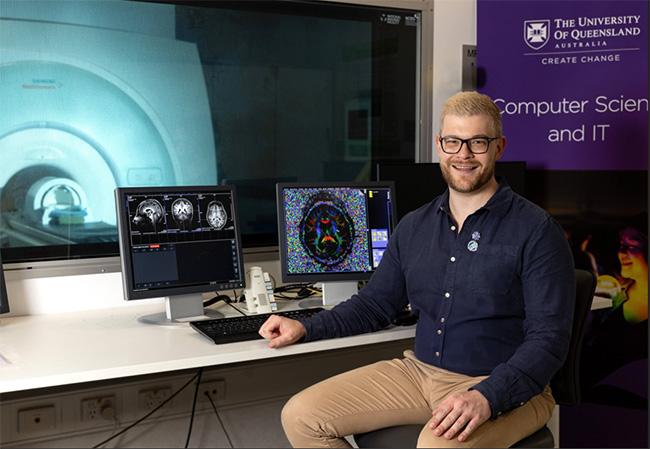
UQ researchers led by Dr Thomas Shaw have developed an AI-assisted tongue labelling approach that uses standard MRI scans to measure tongue muscle shape and volume in both people living with MND and healthy control participants.
Because routine brain scans will often incidentally capture the tongue, the method can take almost all existing clinical scans and measure the tongue muscles with high accuracy, in 3D, without having to complete invasive or specialised procedures.
The team examined more than 200 MRI scans, including those from people living with MND. By leveraging a combination of the latest medical imaging AI-based models and ‘traditional’ advanced image analysis techniques, Dr Shaw and colleagues were able to identify and quantify differences in tongue muscles between people with and without the disease, and over the spectrum of the disease.
The approach provides an objective way to detect and track tongue muscle changes linked to disease progression, while speeding access to care pathways and eventually assisting in clinical trial stratification and endpoints.
What’s the impact?
For people living with MND, earlier detection of tongue muscle deterioration could lead to faster diagnosis, which enables earlier access to clinical trials, support services and voice banking.
We know that tongue degeneration is especially important for both quality of life and the speed with which the disease progresses. Therefore, tools that enable clinicians to monitor disease progression and plan care are a top priority.
The AI methods developed at UQ are now being tested in over 5000 individuals worldwide, by collaborators of Dr Shaw and his team across Australia, China, South Korea, India, The Netherlands and Germany.
Led by
| AI Research Strength | Human-Centered AI |
|---|---|
| Industry Portfolio | Health & Biomedical |
| Key Partners | Royal Brisbane and Women’s Hospital Griffith University Queensland Health Neuroscience Research Australia Google DeepMind The University of Sydney |
| Key Publications | Shaw, T.B. et al. (2025). Segmentation of the human tongue musculature using MRI: Field guide and validation in motor neuron disease. Computers in Biology and Medicine, 196, 110824. DOI: 10.1016/j.compbiomed.2025.110824 Ribeiro, F.L. et al. (2025). An annotated multi-site and multi-contrast magnetic resonance imaging dataset for the study of the human tongue musculature. Scientific Data, 12, 790. DOI: 10.1038/s41597-025-05092-8 |
Published 15 September 2026