
What’s the problem?
Changes in the brain’s smallest blood vessels are linked to cerebrovascular disease, but these vessels are among the hardest structures to see and measure. Ultra-high-field MRI can now capture the arteries of the living human brain in fine detail, but turning those scans into precise maps of the tiniest vessels requires painstaking segmentation. Training AI to do this usually depends on large, manually labelled datasets that are slow and laborious to produce — a bottleneck for research into these small-vessel changes and disease.
What’s UQ’s innovation?
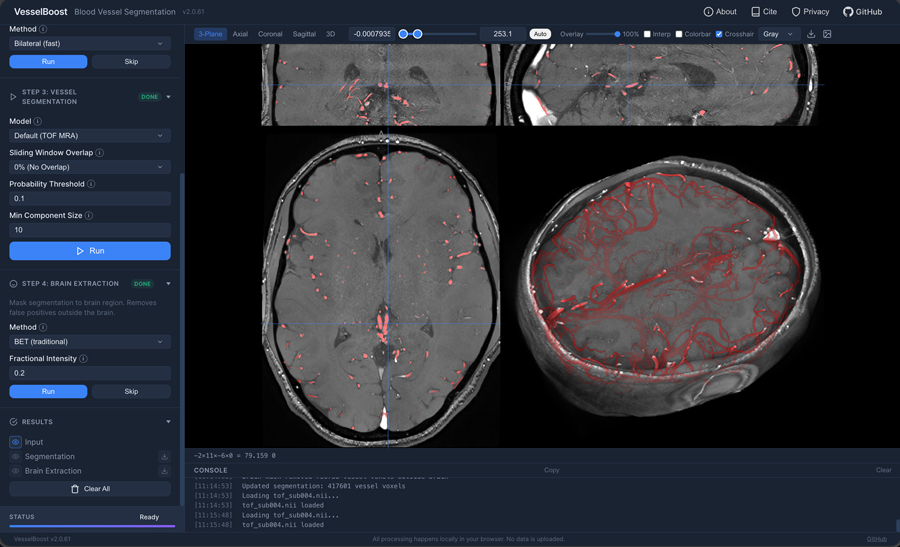
UQ researchers developed VesselBoost, a deep-learning toolbox that automatically segments the brain’s vasculature from MRI angiograms with high sensitivity to small vessels. Its key innovation is a data-augmentation technique that ‘zooms’ in and out on parts of a scan, letting the model learn to trace tiny vessels from larger, easily seen ones — and it can learn from imperfect, roughly labelled data, sidestepping the need for large hand-labelled training sets. VesselBoost offers three modules — predict, test-time adaptation and booster — and is freely available through GitHub and the Neurodesk platform, a web app, and directly on-scanner via Siemens OpenRecon.
What’s the impact?
By improving detection of the smallest vessels and enabling quantitative analysis of vascular geometry and topology, VesselBoost makes detailed, reproducible vessel mapping far more accessible. It supports research into how the brain’s blood supply differs between regions and individuals, and could help identify new imaging markers for cerebrovascular disease. Because it runs on standard research platforms and directly on MRI scanners, other teams can apply it to their own data without building models from scratch.
Did you know?
VesselBoost’s pre-trained models learned to trace the brain’s finest blood vessels from just 14 labelled scans — a fraction of the data most deep-learning models need.
Led by
- Marshall Xu
PhD Researcher, School of Electrical Engineering and Computer Science, UQ
Project Team
- Dr Saskia Bollmann
School of Electrical Engineering and Computer Science, UQ
- Dr Fernanda Ribeiro
School of Electrical Engineering and Computer Science, UQ
- Dr Steffen Bollmann
School of Electrical Engineering and Computer Science, UQ
| AI Research Strength | Data-Centric AI |
|---|---|
| Industry Portfolio | Health & Biomedical |
| Key Publications | Xu et al. (2024) VesselBoost: A Python Toolbox for Small Vessel Blood Segmentation in Human Magnetic Resonance Angiography Data. Aperture Neuro 4. |
| Supporting Link |