
What's the problem?
Understanding how genes, molecules and environmental factors interact to influence biological traits remains one of the biggest challenges in biology. The knowledge needed to build these models exists, but it is scattered across thousands of scientific publications and databases. Constructing mechanistic biological networks typically requires extensive manual review and expert interpretation, making it a slow and labour-intensive process.
This limits researchers' ability to predict the effects of genetic modifications, environmental changes and biological interventions across fields such as agriculture, biotechnology and medicine.
What's UQ's innovation?
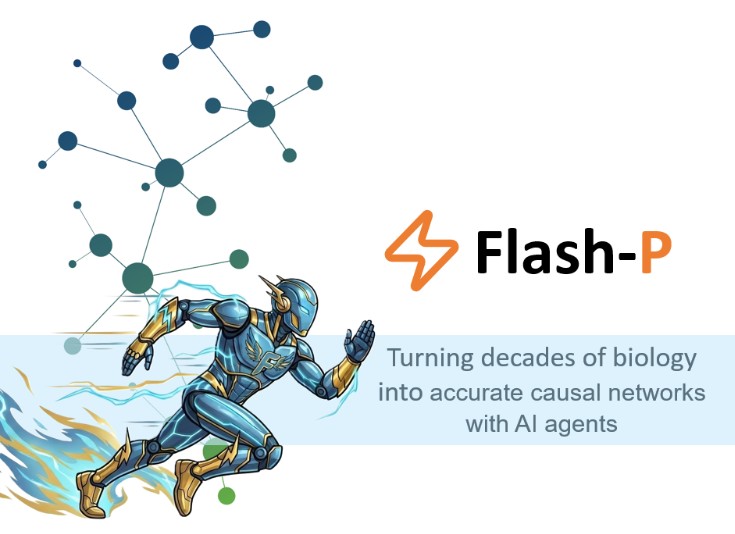
Researchers Dr David Kainer, Mr Christos Mitsanis, Dr Nicole Fortuna and Professor Christine Beveridge have developed FLASH-P, a multi-agent AI system that autonomously transforms scientific literature into predictive mechanistic networks for virtually any trait-species combination.
https://flash-p.com/ FLASH-P uses a team of specialised AI agents that review literature, assess evidence quality, build causal networks, validate predictions and refine results. Rather than simply summarising published research, the system constructs signed, directed biological networks that can be simulated and tested.
The resulting networks provide a framework for exploring "what-if" scenarios, allowing researchers to predict how biological traits may respond to genetic changes, environmental conditions or other interventions. FLASH-P can generate these models in under an hour, dramatically reducing a process that can otherwise take months of expert effort.
What's the impact?
FLASH-P has the potential to accelerate biological discovery by making mechanistic modelling faster, more scalable and more accessible. Researchers can use the system to rapidly generate and evaluate hypotheses before investing in costly laboratory or field experiments.
In validation studies, FLASH-P generated 12 mechanistic networks across seven species and correctly predicted the directional outcomes of 1,088 published genetic and environmental perturbation experiments with a mean accuracy of approximately 90 per cent. The researchers found that FLASH-P outperformed comparison networks derived from conventional knowledge-graph approaches.
Potential applications span crop improvement, agricultural innovation, biotechnology, drug discovery and fundamental biological research, where understanding complex cause-and-effect relationships is critical to solving real-world challenges.
Did you know?
FLASH-P generated causal networks across seven species and accurately predicted the outcomes of more than 1,000 previously published genetic and environmental perturbation experiments, demonstrating the potential of AI agents to automate one of biology's most challenging knowledge-integration tasks.
Led by
- Dr David Kainer
School of Agriculture and Food Sustainability - Mr Christos Mitsanis
School of Agriculture and Food Sustainability
| AI Research Strength | |
|---|---|
| Industry Portfolio | Agriculture, Food & Environment |
| Key Partners | ARC Centre of Excellence for Plant Success in Nature and Agriculture |
| Key Publication | Mitsanis, C., Fortuna, N.Z., Beveridge, C. and Kainer, D. (2026). FLASH-P: Turning decades of biology into accurate causal networks with AI agents. bioRxiv. doi:10.64898/2026.06.13.731799. |
| Supporting Link | http://flash-p.com |
Published 15 September 2026