
What’s the problem?
Mine planning is built on ore grade models derived from drill core sampling. Holes are drilled and assayed at discrete points across a site, and the grade between them is interpolated to build a three-dimensional model of the orebody.
Because drilling is expensive relative to the volume of rock it samples, drill holes are spaced well apart and the true grade of the rock varies at a finer scale than the model can capture. Blasting then moves and mixes material relative to its modelled position. The result is a gap between the modelled ore boundary and the actual ore boundary exposed at the excavation face.
This can lead to dilution, where waste rock is mixed with ore, and loss, where valuable ore is incorrectly classified as waste. Both reduce recovery and increase processing costs.
If ore grade could be measured directly at the point of excavation rather than inferred from a geological model, excavator operators could make more informed decisions about what material to mine and what to leave behind.
What’s UQ’s innovation?
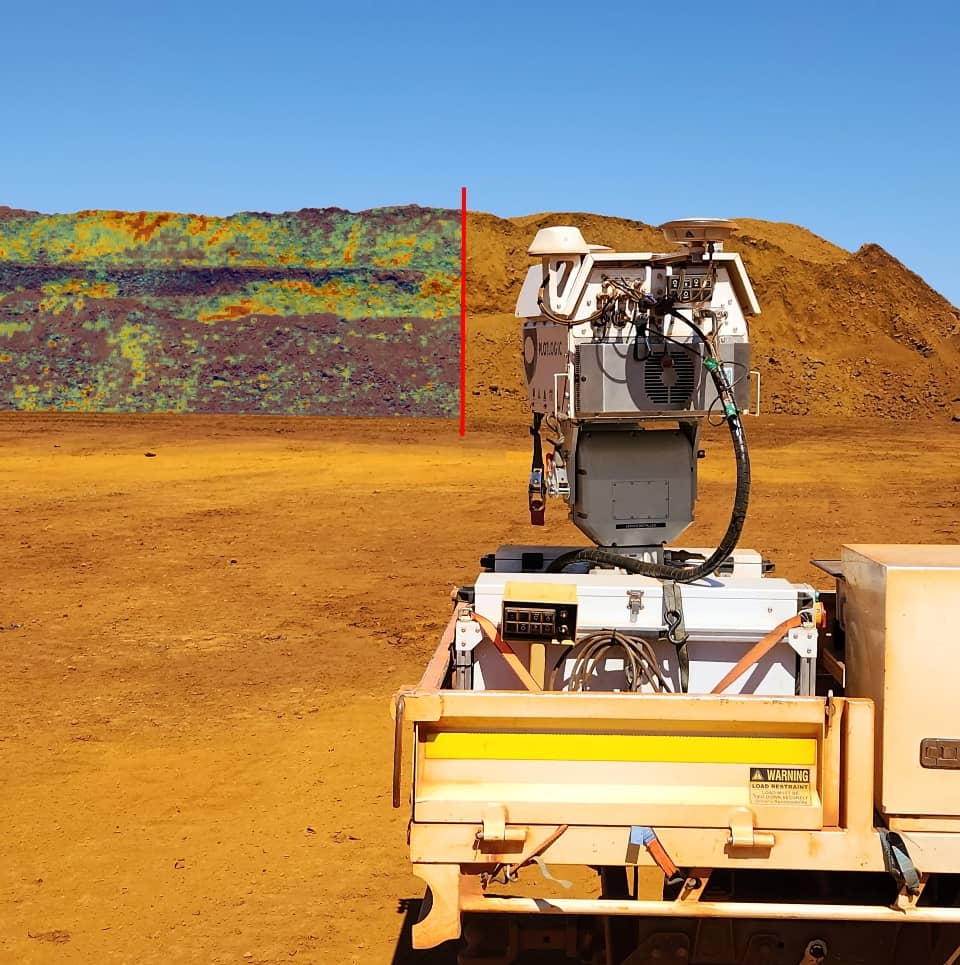
A team in UQ's Smart Machines Group, led by Professor Ross McAree, developed a prototype sensing system to test whether ore and waste rock could be distinguished directly on the excavation face.
The system combines hyperspectral imaging, LiDAR and high-precision positioning technologies. LiDAR is used to build a three-dimensional model of the excavation face, while hyperspectral cameras measure how the rock reflects light across different wavelengths. This information is then aligned with the mine's geological model to create a detailed representation of the exposed rock.
At the centre of the system is a convolutional neural network, a form of artificial intelligence trained to recognise patterns associated with ore and waste. The AI was trained using hyperspectral scans of rock samples whose ore concentrations had been independently verified through laboratory analysis.
By learning the relationship between spectral signatures and ore grade, the system can classify material directly at the excavation face, providing information that would otherwise not be available until after the material had been mined and processed.
What’s the impact?
The research demonstrated that hyperspectral imaging combined with AI-based classification could distinguish ore from waste rock with sufficient accuracy to support selective excavation.
One of the researchers involved in the project, Dr Andrew Job, completed the work as part of his PhD in UQ's Smart Machines Group and subsequently founded Plotlogic to commercialise the technology.
Today, Plotlogic's OreSense platform combines hyperspectral sensing, LiDAR and machine learning to characterise ore in real time on mining equipment. The company has secured significant investment and works with major mining companies including BHP, Anglo American and Glencore.
The project provides a powerful example of how university research can progress from fundamental research and doctoral training to industry adoption, helping improve productivity, reduce waste and increase resource recovery across the mining sector.
Did you know?
This project began as a PhD research project at UQ before evolving into Plotlogic, a mining technology company whose sensing systems are now used by major mining companies around the world.
Led by
- Professor Ross McAree
Head, School of Mechanical and Mining Engineering
UQ PROJECT TEAM
- Dr Andrew Job
Founder and CEO, Plotlogic
PhD researcher on the underpinning UQ project
| AI Research Strength | Data-Centric AI Scalable & Sustainable AI |
|---|---|
| Industry Portfolio | Energy and Resources |
| Key Partners | Plotlogic Pty Ltd Mineral Research Institute of Western Australia (MRIWA) |
| Key Publications | Choros, K.A., Job, A.T., Edgar, M.L., Austin, K.J. & McAree, P.R. (2022). Can Hyperspectral Imaging and Neural Network Classification Be Used for Ore Grade Discrimination at the Point of Excavation? Sensors, 22, 2687. |
| Supporting Link | https://plotlogic.com |
Published 15 September 2026