
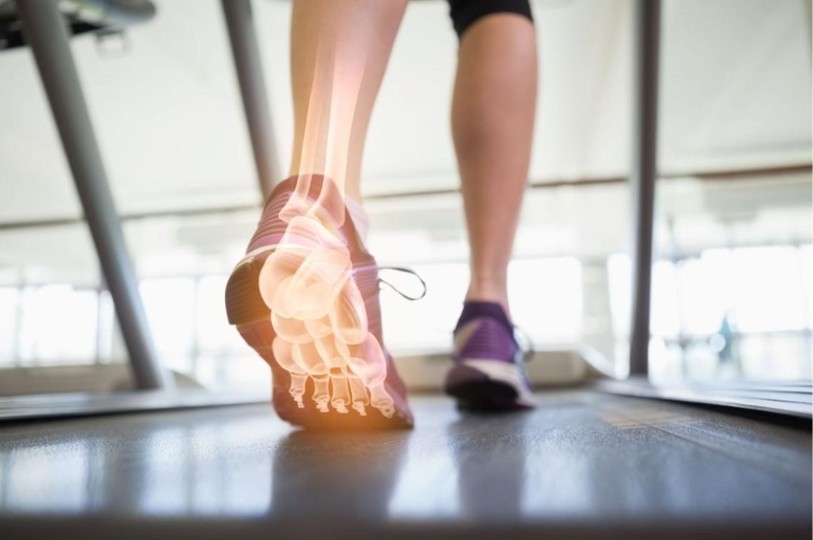
Researchers at The University of Queensland are using AI to reconstruct detailed foot pressure maps from only a small number of measurement points. The technology could support lower-cost foot health monitoring and help improve access to specialist assessment and orthotic care, particularly in rural and remote communities.
What's the problem?
Plantar pressure analysis is widely used to assess foot function, balance, gait mechanics and foot health. It plays an important role in diagnosing conditions and informing the design of orthotics that help prevent or manage foot-related complications.
However, existing pressure-monitoring technologies can be expensive and difficult to access. In-shoe monitoring systems typically rely on large numbers of sensors, increasing cost, complexity and power requirements. These limitations can make foot health assessment less accessible, particularly for people living outside major centres.
What's UQ's innovation?
Researchers Emeritus Professor Martin Veidt, Dr Stuart McDonald and PhD candidate Chongguang Wang from UQ's School of Mechanical and Mining Engineering collaborated with iOrthotics and Healthia Limited to develop a multimodal deep learning system capable of reconstructing high-resolution plantar pressure maps from sparse sensing data.
Using information about foot shape and a small number of anatomical pressure points, the team trained an artificial neural network to generate detailed pressure distributions across the foot. The model achieved strong performance using just 16 anatomical landmarks and produced comparable results using only two landmarks, demonstrating the potential to significantly reduce the number of physical sensors required while maintaining clinically useful information.
The research shows how AI can help overcome limitations of traditional pressure-monitoring systems while retaining clinically useful information.
What's the impact?
The project demonstrates how artificial intelligence can help make healthcare technologies more accessible and affordable.
By reducing reliance on complex sensing systems, the approach could enable foot health data to be collected in more locations, including rural and remote communities where access to specialist services and equipment may be limited. The technology also has potential applications in orthotic design, gait assessment, injury prevention and the management of conditions such as diabetic foot disease.
The research forms part of a broader program led by iOrthotics and Healthia, supported through a $2.2 million Cooperative Research Centres Projects (CRC-P) grant, to develop smarter orthotic technologies for people living in regional and remote Australia.
Did you know?
The team's deep learning model was able to reconstruct detailed foot pressure maps using as few as two anatomical landmarks, demonstrating the potential for accurate foot health assessment with dramatically reduced sensing requirements.
Led by
UQ research team
The project involved Emeritus Professor Martin Veidt, Stuart McDonald, Chongguang Wang, and Gui Wang from The University of Queensland, working in collaboration with researchers and industry partners from Healthia and iOrthotics, including Associate Professor Kerrie Evans, Dean Hartley and Scott Morrison.
| AI Research Strength | Human-Centred AI Data-Centric AI |
|---|---|
| Industry Portfolio | Health & Biomedical |
| Key Publication | Wang C, Evans K, Hartley D, Morrison S, McDonald S, Veidt M, Wang G. Multimodal Feature-Level Fusion CBAM U-Net for Static Plantar Pressure Prediction Using Plantar Geometry and Sparse Anatomical Landmarks. Sensors. 2026;26(13):4143. doi:10.3390/s26134143 |
| Supporting Link | https://news.uq.edu.au/2026-08-study-shows-ai-could-support-low-cost-foot-health-technology |
Published 15 September 2026