
What’s the problem?
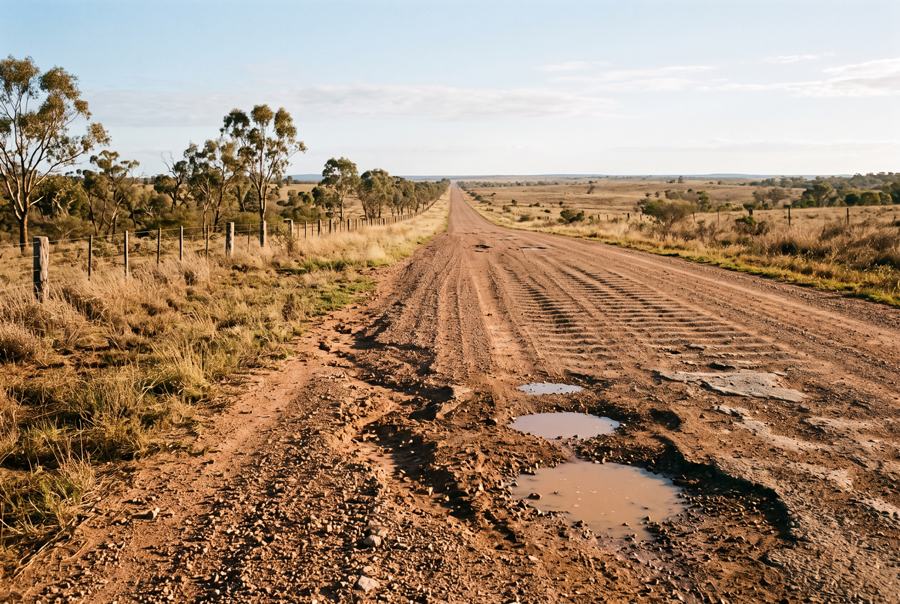
Australia’s 413,000 km of unsealed local roads are critical to regional life. They carry farm produce to market, connect families to school, work and town, and are the lifeline for remote and Indigenous communities. Yet they are managed by small rural councils with few staff and limited budgets, and the networks are far too vast to inspect regularly. The pressure is greatest after floods and cyclones, when enormous lengths of damaged road must be assessed at once. AI offers a way to inspect at this scale. Unlike sealed roads, however, unsealed roads vary in material from region to region, and a model that learns to identify damage on one region’s gravel also learns the appearance of that gravel. Trained in one place, it performs poorly wherever the surface is different.
What’s UQ’s solution?
Researchers from the School of Civil Engineering are addressing the reason AI road inspection has yet to work reliably on unsealed roads. The field has concentrated on sealed roads, where the surface is much the same everywhere, and unsealed roads offer no such uniformity. The team is using generative AI to develop a model that identifies damage independently of the material around it, so that it can be relied on as the surface changes from place to place. The aim is a single, transferable system that delivers consistent, objective condition assessments for any unsealed road, anywhere, without being rebuilt region by region.
What’s the impact?
For councils, the result is faster inspections, reliable data, and maintenance funding directed to where it is needed most. For the farms, families and remote communities that depend on those roads, it means earlier repairs, safer travel, and quicker recovery when a flood or cyclone cuts the network. Because a model developed elsewhere needs no retraining on local roads, a small remote shire receives the same quality of assessment as a well-resourced regional city. The approach is not limited to roads. Cracks, corrosion and wear look much the same on rail lines, bridges, tunnels or building facades, but the surfaces around them differ widely. AI inspection in those fields faces the same difficulty, and stands to gain from the same solution.
Led by
James O’Kane
PhD Candidate, School of Civil Engineering
PROJECT TEAM
- Dr Jurij Karlovšek
School of Civil Engineering
| AI Research Strength | Sustainable and scalable AI Data-Centric AI |
|---|---|
| Industry Portfolio | Urban Design & Infrastructure |
Published 15 September 2026