
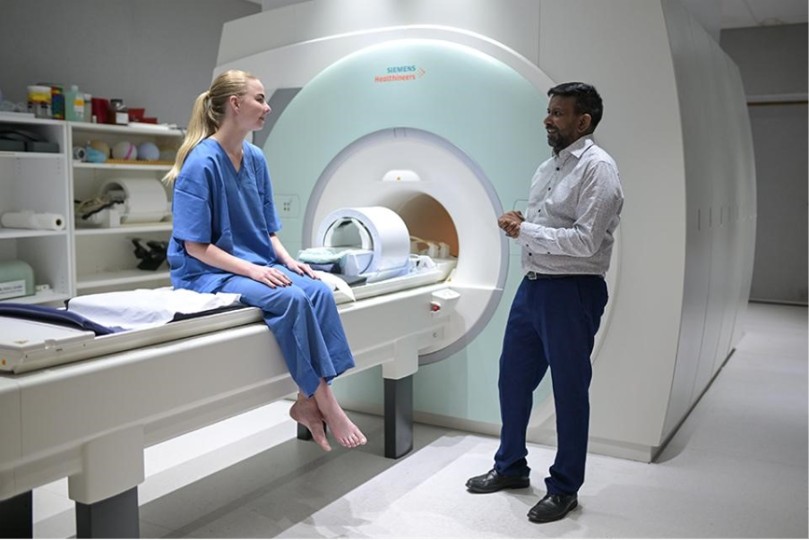
Osteoarthritis affects millions of people worldwide and is one of the leading causes of pain, reduced mobility and disability. UQ researchers - in partnership with the CSIRO and Siemens Healthineers - have developed an AI-enabled tool that automatically analyses knee MRI scans, helping researchers and clinicians better understand the disease and accelerating the search for MRI-based biomarkers that could improve diagnosis and treatment.
What's the problem?
Osteoarthritis is a progressive disease characterised by the breakdown of cartilage within joints. Despite affecting millions of people worldwide, clinicians still lack reliable biomarkers that can detect disease progression early and help predict treatment outcomes.
MRI scans can provide detailed information about joint health, but analysing those scans manually is time-consuming and labour-intensive. This limits the ability of clinicians and researchers to study large datasets and identify subtle changes associated with disease progression.
What's UQ's innovation?
Researchers led by Dr Shekhar (Shakes) Chandra from UQ's School of Electrical Engineering and Computer Science, working with CSIRO and Siemens Healthineers, developed Chondral Quant, an AI-enabled software tool that automatically analyses knee MRI scans.
The system uses machine learning to identify and measure structures within the knee that are important to osteoarthritis, including cartilage and bone. Tasks that traditionally required hours of manual image analysis can be completed in approximately three minutes, enabling researchers and clinicians to process much larger volumes of imaging data.
Beyond measuring cartilage volume and thickness, Chondral Quant enables quantitative assessment of cartilage physiology, supporting efforts to identify MRI-based biomarkers that could improve monitoring and management of osteoarthritis. The work also contributes to the development of digital twin models of the knee joint using advanced MRI and machine learning.
What's the impact?
By automating MRI analysis, Chondral Quant has the potential to improve both osteoarthritis research and clinical assessment. Faster image processing allows researchers to investigate disease progression at scale and supports clinicians in making more informed treatment decisions.
The technology supports efforts to identify MRI-based biomarkers that could improve the early detection and monitoring of osteoarthritis, potentially enabling more personalised intervention strategies.
Importantly, the software has already progressed beyond the research stage. Chondral Quant has received FDA clearance and is available for clinical use in United States, Australia, Canada, New Zealand, Brazil, India, Malaysia, Korea, Switzerland, Turkey and the European Union.
Did you know?
Chondral Quant can reduce knee MRI cartilage analysis from hours of manual work to approximately three minutes, allowing researchers to investigate osteoarthritis at a scale that would otherwise be impractical.
Led by
| AI Research Strength | Human-Centred AI |
|---|---|
| Industry Portfolio | Health & Biomedical |
| Key Partners | CSIRO Siemens Healthineers UQ Centre for Advanced Imaging |
| Key Publications | W. Dai et al., “CAN3D: Fast 3D medical image segmentation via compact context aggregation,” Medical Image Analysis, vol. 82, p. 102562, Nov. 2022, doi: 10.1016/j.media.2022.102562. B. Woo, C. Engstrom, W. Baresic, J. Fripp, S. Crozier, and S. S. Chandra, “Automated anomaly-aware 3D segmentation of bones and cartilages in knee MR images from the Osteoarthritis Initiative,” Medical Image Analysis, vol. 93, p. 103089, Apr. 2024, doi: 10.1016/j.media.2024.103089. W. Dai, S. Liu, J. Fripp, C. Engstrom, and S. S. Chandra, “Interpretable Semantic Medical Image Segmentation With Style and Confidence,” IEEE Transactions on Pattern Analysis and Machine Intelligence, vol. 48, no. 09, pp. 10504–10517, Sep. 2026, doi: 10.1109/TPAMI.2026.3689564. |
Published 15 September 2026