
How AI can help students learn - not just hand them the answer
Generative AI can answer questions, write essays and summarise to a professional standard — allowing students to complete tasks while bypassing the effort through which understanding is built. Offloading their thinking to AI means students may lack the judgement, problem-solving capabilities and deep understanding required to create original solutions to real-world challenges. Unequal access to AI and effective guidance also risks widening existing educational inequities.
A University of Queensland (UQ) team has developed RiPPLE, an evidence-based platform with embedded AI learning companions designed to question, scaffold and explain rather than simply answer – prioritising lasting understanding over immediate performance. Used by more than 100,000 students over a decade, RiPPLE is now being developed into a scalable product for schools and universities.
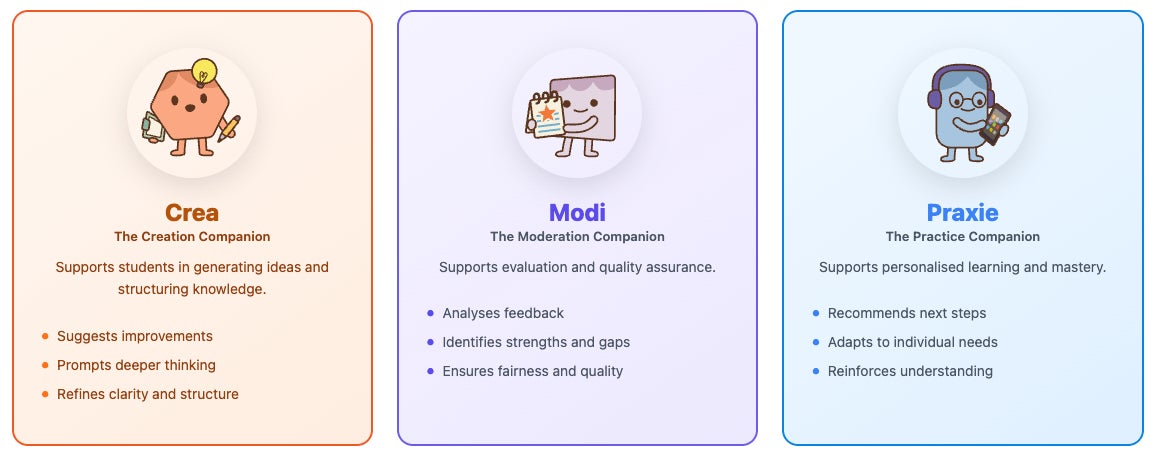
At a glance
- RiPPLE is an evidence-based learning platform that helps students create, evaluate and practise course-aligned activities, supported by AI companions that question, scaffold and explain rather than supply answers.
- RiPPLE improves learning, engagement and academic performance while giving every student the same course-aligned AI support, regardless of what commercial tools they can access.
- The platform, which has supported more than 100,000 students across 400+ courses, is being translated into a scalable product for schools and universities.
What's the problem?
Studies have shown that students who use AI produce stronger work while they have access to the technology, then fall behind their peers who never used AI once it is removed. The output improves while the learner does not – the learning–performance paradox.
This occurs because generative AI removes the effortful work that builds expertise. Students who use AI are at risk of not developing their ability to devise original solutions, judgement and disciplinary understanding – skills that are crucial for the future but cannot be supplied by AI.
The students who gain most from AI use are those who can afford the best tools, know how to direct them and have the confidence to challenge them – which tend to be educationally-advantaged students. AI access is thus also an equity issue that can sort students by resources rather than effort.
What's UQ's innovation?
RiPPLE puts the student at the centre of a learning ecosystem that includes evidence-based activities that support true learning, not just providing answers. Students generate ideas, explain their reasoning, judge the quality of others’ work and act on feedback, supported by a coordinated mix of educators, peers and purpose-built AI companions.
The companions are designed to question, scaffold and explain rather than generate an answer – so the cognitive effort, and the accompanying learning, stays with the student. The companions are connected to curriculum, tasks and assessment rather than waiting to be opened, so they can initiate support rather than only respond. The assistance provided adapts and deliberately fades as student capability grows.
Because RiPPLE is provided as part of the course, every enrolled student receives the same course-aligned AI support at no personal cost — regardless of what commercial tools they could otherwise afford.
How does technology work?
A Create–Evaluate–Practice cycle grounded in learning science
RiPPLE is built around a repeating cycle. In Create, students write their own learning resources — such as multiple-choice questions with plausible wrong answers — which forces them to explain a concept and anticipate where others may go wrong. In Evaluate, they review their peers’ work, building the judgement to tell a good answer from a bad one. In Practice, students revisit each concept through questions timed to reappear just before a student would forget them, with topics spaced out and mixed by difficulty so each review is timed for maximum effectiveness. Evidence from each activity determines what support comes next, so assistance adapts to individual student need.
What makes a “learning companion” different
RiPPLE’s AI companions are built to four design rules. They are pedagogically grounded, meaning their behaviour is shaped by how people actually learn; they are adaptive — a learner model draws on each student’s performance, contribution history, peer evaluations and recurring misconceptions to decide when to prompt recall, offer a hint, or step in. The AI companions are responsibly designed so the reasoning behind a recommendation can be inspected and explained, and they are embedded — connected to the curriculum, tasks and assessment rather than waiting to be opened, so an AI companion can begin a conversation rather than wait for the student to initiate.
What is the impact?
RiPPLE produces measurable improvements in learning, student engagement and academic performance, evidenced by two independent peer-reviewed studies — the former from a UQ study of 453 students, and the two latter from a separate, multi-campus study of 2,095 students – demonstrating that RiPPLE’s effectiveness is retained across different institutional contexts.
At scale, RiPPLE allows students to receive personalised feedback at a scale simply not possible for a human teaching team – the platform has delivered AI-supported feedback across more than 70,000 instances of resource creation and 300,00 peer reviews. Students rated both of these interactions above 4.2 out of 5, demonstrating that students feel this mode of feedback is useful.
The platform underpins more than 30 peer-reviewed publications, including work identifying which kinds of AI feedback actually drive revision and reflection rather than task completion. It was named a finalist for Queensland AI Research Project of the Year at the 2024 Queensland AI Awards.
Did you know?
RiPPLE has been used by more than 100,000 students across 400+ courses, generating over 300,000 student-created resources and more than one million peer reviews.
What's next?
The UQ team is turning RiPPLE from a research platform into a commercial-ready product for Australian schools and universities, supported by funding from the Australian Economic Accelerator’s Ignite program, with international commercialisation to follow. There are active pilots at 10 institutions across Australia, Canada, the United State, New Zealand and Hong Kong, with product-market fit validated through interviews across 15 universities and schools.
A partnership with the Queensland Department of Education will test the approach with approximately 85,000 Year 9 and 10 students — the largest trial yet of whether these designs work beyond selective higher education.
Finally, the team are committed to measuring what students retain, transfer and can do independently after support from RiPPLE is withdrawn, with a project spanning Australia, New Zealand and Hong Kong. The team is seeking institutional partners to run RiPPLE in credit-bearing courses in these nations to contribute to this evidence base.
“I found creating a question to test others’ knowledge ended up testing myself more.”
- RiPPLE student
The team
RiPPLE is led by A/Prof Hassan Khosravi and co-developed by Nick Joseph within UQ's Institute for Teaching and Learning Innovation. Its combination of learning science, AI research and sustained software development allows design principles to be tested in authentic use and refined against evidence.
UQ Research and Development Team
| A/Prof Hassan Khosravi | Project lead |
| Nick Joseph | Co-developer |
Selected Academic Collaborators
- Monash University
- The University of Auckland
- The University of Adelaide
- Simon Fraser University
- University of Nottingham Ningbo China
- La Trobe University
Collaborators
- Queensland Department of Education
Funders and Supporters
- Australian Economic Accelerator - Ignite
- UniQuest
- UQ Teaching Innovation Grants
Project details
| AI research strength | Human-Centred AI Data-Centric AI Responsible AI |
|---|---|
| Industry portfolio | Social and Economic Policy |
| Project hub | ripplelearn.ai app.ripplelearn.ai |
| Key publications | Khosravi, H., Kitto, K., & Williams, J. J. (2019). RiPPLE: A crowdsourced adaptive platform for recommendation of learning activities. Journal of Learning Analytics, 6(3), 91–105. https://doi.org/10.18608/jla.2019.63.12 Khosravi, H., Denny, P., Moore, S., & Stamper, J. (2023). Learnersourcing in the age of AI: Student, educator and machine partnerships for content creation. Computers and Education: Artificial Intelligence, 5, 100151. https://doi.org/10.1016/j.caeai.2023.100151 Darvishi, A., Khosravi, H., Sadiq, S., Gašević, D., & Siemens, G. (2024). Impact of AI assistance on student agency. Computers & Education, 210, 104967. https://doi.org/10.1016/j.compedu.2023.104967 Alsaiari, O., Baghaei, N., Lahza, H., Lodge, J. M., Boden, M., & Khosravi, H. (2025). Emotionally enriched AI-generated feedback: Supporting student well-being without compromising learning. Computers & Education, 239, 105363. https://doi.org/10.1016/j.compedu.2025.105363 Alsaiari, O., Baghaei, N., Lodge, J. M., Noroozi, O., Gašević, D., Boden, M., & Khosravi, H. (2026). Directive, metacognitive, or a blend of both? A comparison of AI-generated feedback types on student engagement, confidence, and outcomes. Computers and Education: Artificial Intelligence. sciencedirect.com/science/article/pii/S2666920X26000147 Khosravi, H., et al. (2026). Building AI companions that prioritise learning over performance. arXiv:2605.04816. https://arxiv.org/abs/2605.04816 |
| Research library | ripplelearn.ai/research |
Interested in working with this team?
100 UQ AI Innovations Changing the World · Showcasing 100 projects creating change through AI